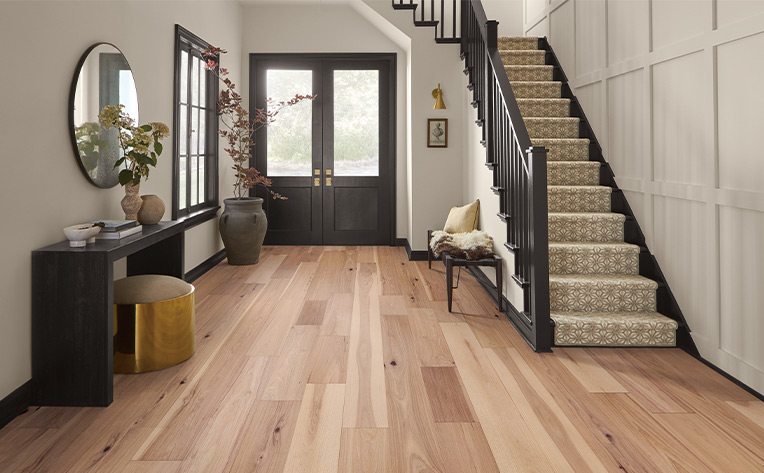
Both engineered hardwood and laminate have the appearance of real wood, but they're built differently and perform differently depending on where and how you live. If you're weighing the two, here's what to know before you decide.
Engineered hardwood is a multi-layer flooring product built with a real wood veneer on top and a core made from plywood or high-density fiberboard (HDF). That veneer is cut from actual hardwood timber, so the surface grain, texture, and character you see are completely genuine.
Unlike solid hardwood, which is milled from a single piece of wood, engineered hardwood's layered construction makes it more dimensionally stable. The core resists the expansion and contraction that comes with changes in humidity and temperature, which means it can be installed in spaces where solid hardwood typically struggles, like basements or rooms with radiant heat.
Engineered hardwood is available in a wide range of species, including white oak, red oak, maple, and hickory, each bringing its own grain pattern and natural character. Finish options range from matte and satin to high-gloss, with wire-brushed and hand-scraped textures available for a more lived-in look.
Pro Tip: engineered hardwood is water-resistant, not waterproof. It can handle everyday spills when cleaned up promptly, but prolonged moisture exposure can still cause damage.
Laminate flooring is a multi-layer product built around a high-density fiberboard (HDF) core, topped with a photographic design layer and sealed with a protective wear layer. The core is made from compressed wood fibers, which gives laminate its structure and stability.
The design layer is where modern laminate technology really stands out. Advanced printing and embossing techniques allow manufacturers to replicate the look and texture of hardwood with a high degree of realism. Running your hand across a quality laminate plank, you'll feel texture that mirrors the grain or surface it's imitating, not just a flat printed image.
It's worth noting that while the HDF core is derived from wood fibers, laminate contains no real wood on its surface. What you're seeing is a photograph, not a real piece of wood. The wear layer on top provides solid scratch resistance, making laminate a durable option for active households and high-traffic areas.
Laminate is water-resistant but not waterproof. Spills should be wiped up promptly, since standing moisture can work its way into seams and potentially cause swelling or damage over time. While both flooring types are designed to handle everyday life, there are also 100% waterproof options available, which may be a better fit for areas with heavier moisture exposure.
Both floors can look like natural wood and work in similar spaces, but how they're built affects how they perform over time. Here's how they compare across the factors that matter most.
Appearance
The grain and texture on engineered hardwood are genuine, cut from real hardwood species like white oak, maple, or hickory. Laminate's appearance comes from a printed image, which modern technology renders with impressive realism.
Both engineered hardwood and traditional laminate flooring are water-resistant, not waterproof. Spills need to be cleaned up promptly with either option. If waterproof performance is a priority, fully waterproof laminate is the better fit for your space.
Laminate generally offers stronger scratch resistance thanks to its wear layer, making it a solid choice for households with pets or heavy foot traffic. Engineered hardwood is also highly durable, with a real wood surface that can hold up well to everyday use, and depending on the thickness of the veneer, it may be refinished once or twice to extend its lifespan and restore its appearance over time.
Depending on veneer thickness, engineered hardwood can be lightly sanded and refinished once or twice, which can extends its lifespan. Laminate cannot be refinished. When the wear layer is gone, the floor needs to be replaced.
Both have options for a variety of budgets. Engineered hardwood typically carries a higher price point than laminate, reflecting the cost of real wood materials. Laminate offers a more accessible entry point while still delivering a wood-look result.
Both products can be installed as a floating floor, which makes for a quicker and more straightforward installation process. Engineered hardwood also supports nail-down and glue-down installation methods, giving it added flexibility across different subfloor types and project requirements.
Solid hardwood is milled from a single piece of wood, making it the most authentic option available. It can be refinished multiple times over its lifespan, and with proper care it can last for generations. That authenticity comes at a price, though. Solid hardwood is typically the most expensive of the three options and the most sensitive to moisture and temperature changes.
Because of that sensitivity, solid hardwood is not recommended for below-grade installations like basements, and it requires more careful climate control to perform well over time.
For spaces where solid hardwood isn't practical, engineered hardwood delivers genuine wood character with better stability, while laminate offers a wood-look result at an often more accessible price point.
The right choice often comes down to where the floor is going.
The better floor depends on what you're prioritizing. Choose engineered hardwood if real wood authenticity matters to you. The genuine grain, the natural warmth underfoot, and the ability to refinish make it worth the investment for many homeowners, particularly in living spaces where your floor is the focal point.
Choose laminate if scratch resistance and budget are your primary considerations. It delivers a convincing wood-look result, holds up well in active households, and often comes in at a lower price point without sacrificing much on appearance.
Both engineered hardwood and laminate are water-resistant, but neither is waterproof. For kitchens, basements, or any space where moisture is a real concern, choose a 100% waterproof laminate option for a more reliable long-term choice.
Neither is objectively better. The right choice depends on your priorities. Engineered hardwood offers genuine wood character, a warmer feel underfoot, and the option to refinish. Laminate offers stronger scratch resistance and typically comes at a lower price point. For most living spaces, engineered hardwood is worth the investment if authenticity matters. For high-traffic areas or tighter budgets, laminate is a practical and attractive alternative.
The biggest limitation is that laminate cannot be refinished. Once the wear layer is worn through, the floor needs to be replaced. Traditional laminate is also water-resistant but not waterproof, so prolonged moisture exposure can cause the HDF core to swell. Despite advances in printing and embossing technology, laminate doesn't fully replicate the feel of real wood underfoot.
While it's more stable than solid hardwood, engineered hardwood is still not waterproof and isn't recommended for bathrooms or below-grade spaces. Depending on veneer thickness, refinishing options may be limited, and thinner veneers may only support one refinish over the floor's lifespan.